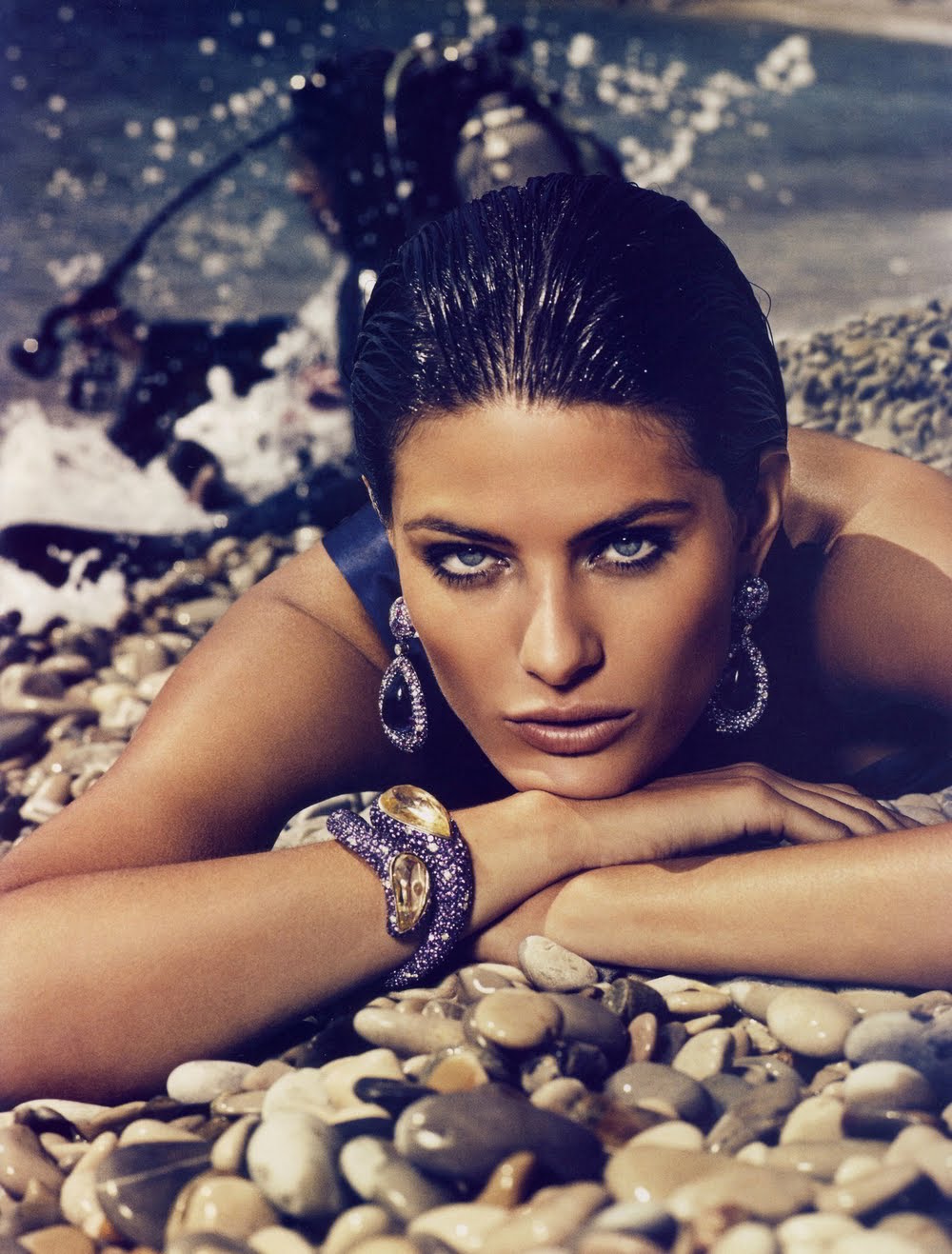
 Born in Brazil on the 4th July 1983, Isabeli Fontana is one of fashion’s longest-serving models, now clocking up her 12th year in the industry.
 In interviews, Isabeli describes being drawn towards modelling from childhood, competing in Brazil’s Elite Model Look contest at the age of 13. Placing third in the competition, Fontana moved to Milan in 1997 to actively pursue a modelling career.
Fontana made her runway debut in 1999, walking for Givenchy, Michael Kors and Versace. Isabeli also started what would become a famously-diverse career with her first booking for Victoria’s Secret catalogue.
In March 2002, Isabeli got the cover of French Vogue. The publication took to the Brazilian model immediately, re-booking her extensively throughout her career. Just as they have recently done with Lara Stone, French Vogue continues its role as mentor to new faces, and Fontana is one of their most prolific success stories.
Isabeli took a break from modelling in 2003 after giving birth to her son, Zion. Returning in 2004, Fontana had been much-missed and got booked for an once-in-a-lifetime shoot with Richard Avedon for Hermes.
Her return was celebrated by American Vogue, who placed her on their September cover. Naming Fontana as one of the world’s next top models, Isabeli went on to book a 53-show season for Fashion Week, including appearances for Donna Karan, Marc Jacobs, Vera Wang and Zac Posen.
2005 saw Fontana score her second cover with French Vogue in June and later that year, she signed a fragrance contract with Viktor and Rolf. Named ‘Flowerbomb’, the early controversy over the name gave way to the perfume becoming one of the industry’s most enduring sellers. Still marketed today as one of the world’s most popular fragrances, ‘Flowerbomb’ has become a modern classic. Isabeli’s campaign shot – ethereal but with a couture sensibility running through it – has remained the defining image of the perfume. Six years on, Isabeli remains the face of ‘Flowerbomb’, an achievement especially impressive when you consider how frequently some perfume houses change their models.
Isabeli hit another career marker when she walked in the 2007 S/S Prada show in Milan. Finishing off 2007 with a cover of Brazilian Elle and editorials for W and French Vogue, Isabeli hit the headlines in April 2008 when she was named by Forbes as the 11th highest paid model in the world. Having reportedly earned $3million in 2007, Fontana boosted her income with yet more lucrative campaigns. Signing with Belstaff, Roberto Cavalli, Valentino and Versace, Isabeli filled the rest of the year with runway and editorial work, ending with the cover of Numero in December.
Opening 2009 with a German Vogue cover, Isabeli got the chance to take part in a very special shoot. Featuring in May’s American Vogue, Isabeli appeared in ‘The Godfather’, a tribute to legendary photographer Steven Meisel, who himself made a rare appearance on camera. Meisel is renowned for spotting and nurturing talent, creating some of fashion’s most memorable moments from his recent plus-size cover for Italian Vogue to his long-standing associations with Balenciaga, Mulberry and Prada. Photographed by Meisel for the A/W Roberto Cavalli campaign, Fontana was a perfect choice for the brand: strong, confident and sexy. With clothes that are deliberately a challenge to wear, Isabeli was more than a match for the heady Cavalli designs.
Fontana worked with Meisel again in January 2010 when she appeared in the mega-editorial ‘Runway’. Isabeli hit another high-point featuring in the French Vogue editorial ‘Vogue-a-Porter’, a preview of S/S trends. Playing against type, Fontana was a tattooed tomboy in stripes and hair-gel. Featuring on covers for Japanese and Mexican Vogue, in June Isabeli featured in a French Vogue editorial that was tailor-made for her. In ‘L’Heure Bleu’, Isabeli worked the sun-soaked smoulder to perfection. Keeping the sizzle but still showcasing the fashion, Fontana made it look alarmingly easy.
In October, Isabeli closed the S/S show for Isabel Marant, also walking for Chanel, Balmain, Hakaan, Michael Kors, Oscar de la Renta and Proenza Schouler. At this point, Fontana had been working in the industry for over 10 years. Maintaining this level is a rare occurrence in the fashion industry, putting Fontana in the same bracket as Angela Lindvall, Carmen Kass and Kate Moss.
Finishing off 2010 with a Brazilian Vogue cover, shot by father-and-son team Patrick and Victor Demarchelier, Isabeli then made a splash in 2011 appearing in the S/S ad for Dolce and Gabbana. Shot entirely in black and white, the cinematic style of the ads created one of the most striking campaign images of the season, charting Dolce & Gabbana’s roots in classic, Italian style.
Fontana’s next campaign booking was a complete 180 from the va-va-voom favoured by Dolce & Gabbana. Photographed for the Jil Sander collection made especially for high-street store Uniqlo, Isabeli is decked out in cosmopolitan chic. The two campaigns could not be more different, but neither feels like a wrong fit.
Filling April and May with editorials for Spanish and French Vogue, June saw Fontana hit a career high-note that reminded the fashion industry of why she is such a special find. Appearing on the cover and in the pages of French Vogue, Isabeli worked with Mert Alas and Marcus Piggott to pay homage to a 1990 Italian Vogue photo-shoot from Steven Meisel and Linda Evangelista.
The results were incredible. In a short, cropped wig, Isabeli became Evangelista. The cover and editorial were such a huge hit they were even featured in the mainstream press. Every model needs a ‘moment’, and Isabeli’s career has been filled with them. Fontana’s editorial may make us nostalgic for the heyday of the supermodel, but the genius of the shoot is that Isabeli’s rendition is so perfect because she is a master of editorial work, a very modern modelling skill. What for many would be a career-best performance is all in a day’s work for Isabeli.
Where we leave Isabeli now is on the news that she has clinched two major campaigns for A/W 2011. Working for Dolce & Gabbana again, plus Italian luxe label Bottega Veneta, these coveted bookings show just how Isabeli has remained current in a rapidly shifting industry. Where the tastes and definitions of beauty are constantly changing, Isabeli has met them all.
Isabeli’s inclusion in the latest campaign for Dolce & Gabbana is more than a courtesy booking. Working alongside new faces such as Kate King, Liu Wen, Maryna Linchuk and Constance Jablonski, Fontana effortlessly stands out. There’s next to no flesh on display in this ad, but the resulting photos are undeniably sexy. Dolce & Gabbana make clothes for women who want to reveal, not expose. That difference can often be subtle, and Fontana knows how to portray sexuality in a way that sells fashion first. Isabeli has graced the pages of the Pirelli calendar four times, and appeared in Sports Illustrated famous swimsuit edition. But she’s also the face of Louis Vuitton, Balenciaga, Ralph Lauren and Valentino.
Isabeli’s strength is that she is a true chameleon. The Linda Evangelista spread in French Vogue is so striking because Fontana and Evangelista are essentially two of a kind. From Victoria’s Secret to Chanel Couture, Fontana has been every kind of model. Her achievement is made all the more extraordinary when you consider how much the fashion world has changed since Isabeli’s debut in New York Fashion Week, 1999.
The no-nonsense minimalism of the Nineties was making way for an exuberant, decadent movement that was all about show. Details took centre stage, with the must-have item of the year being Gucci’s boho-luxe feathered jeans. In a gut-reaction to minimalism, fashion went for decoration, and the more, the better. The details all pointed to a bigger picture that rejected the low-key, invisible branding of the mid-Nineties in favour of indulgence and visible wealth.
Fast forward to 2011, and detail is making a return, but the clothes look very different. We’re all a little battered and bruised from the events of the past 12 years. Boom and bust has not been kind to anyone, but the high-fashion luxury market is making a comeback.
The key difference now is that those able to make large purchases are buying less dazzle and more substance. The emphasis is on the luxury you can’t see. Brands that make keep-for-life pieces such as Mulberry are doing particularly well. The age of the brand isn’t over; it’s just a little more discreet.
The big story of A/W 2011 is texture; shearling, tweed, wool and leather. Thoroughly tactile and encouraging the wearer to engage with the clothes, the industry has moved from celebrating how fashion looks to how it makes you feel. Fashion’s often been criticised for being shallow, but it’s undergone a transformation that’s body and soul.
That change has been partly organic – fashions are designed to come and go – but also change that’s been imposed from outside forces. Fashion reflects what’s going on in the world, but it does more than passively show and tell. It translates as quickly and deftly as any broadsheet.
It’s said that change is the only true constant, and nowhere is this truer than in the fashion world. As one of fashion’s greatest translators, Isabeli’s reputation as an out-and-out chameleon has created a career that’s without equal. Bold, exciting and wholly unpredictable – Isabeli Fontana’s next move really is anyone’s guess.
HELEN TOPE


